Stigmatizing and marginalizing – education’s ongoing conundrum
There is a considerable overlap in what is generally understood by ‘stigmatization’ and ‘marginalization’ in education. The former may refer to having a mark of shame or disgrace which is associated with a particular quality or characteristic; the latter to being ostracized or regarded as an interloper or outsider. Both lead to exclusive practices in education. Often these occurrences are unintentionally influenced by the attitudes and decisions of officials, staff, parents/carers, or pupils. Depending on the context, there is what might be described as an ‘othering continuum’. It ranges from the likes of being demeaned through name-calling by classmates, inadequate advice, the spreading of malicious rumours on social media, and onwards to an extremity of embracing the mantel of hate crime, as for instance, physical assaults on minority groups.
Experiencing inequality and living in underprivileged circumstances gnaws away not only at a community’s social fabric but also increases the hazard of students feeling both alienated and powerless. To make matters worse, young persons and their parents and carers living in these environments may be cut off from support services and benefits to which they are entitled. There is need to recognise and accept that ill-judged and unsuitable educational experiences can contribute to apprehension and low self-esteem among learners of all ages. A key twofold aim of scholarship must be to eradicate stigmatization and marginalization and, in their place, to establish authentic inclusiveness. Flexible, individualised, pupil-centred programs to enable them to gain positive insightfulness regarding their worth and latent abilities can prove to be invaluable. When implemented effectively they can prevent pupils from being treated as scapegoats and objects of derision.
From the beginning of their lives, the sidelining and downgrading of individuals often arise due to features such as physical disabilities, accents, dyslexia, exceptional talents, unusual interests, mental health issues, and social deprivation. Some are experiencing a multiple of disadvantages. Those who have endured poverty from birth, adverse childhood experiences (ACEs), and other trauma-induced occurrences are often targets for ridicule and exclusion. The authentic uniqueness and social identity of children may be threatened and they risk being manipulated into adopting false self-images. Under severe pressure, perhaps related with mental health problems, the injured parties begin to believe that they are incompetent and without merit.
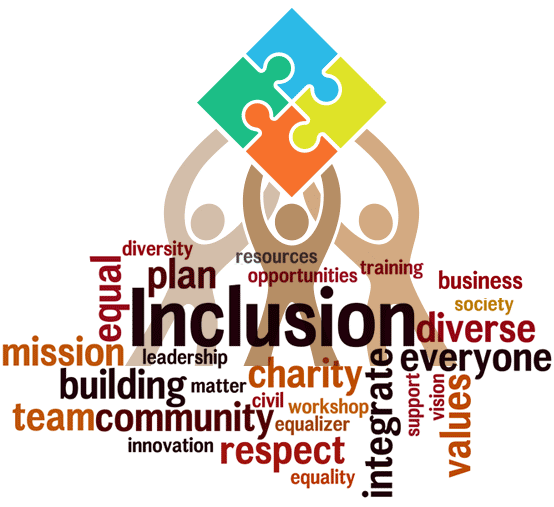
Identifying potential obstacles to the formation of inclusive education
Unsurprisingly, there is a variety of interpretations and expectations, some which at first might appear to be contradictory, of what inclusive education entails. Such variations can be found, not only on a world-wide scale from one country to another, but also across local authorities within the same nation. Of course, depending on where they live, children can have very restricted opportunities to attend school and many simply have no access whatsoever to a formal education. However, The Convention on the Rights of Persons with Disabilities (United Nations) in Article 24 on education declares that “Inclusion involves a process of systematic reform embodying changes and modifications in content, teaching methods, approaches, structures and strategies in education to overcome barriers with a vision serving to provide all students of the relevant age range with an equitable and participatory learning experience and environment that best corresponds to their requirements and preferences.” A follow-up report, this time by the Committee on the Rights of Persons with Disabilities, has been highly critical of the state of educational inclusiveness in the United Kingdom and there has been little evidence of significant improvement in recent years.
One perspective is that inclusive education is largely a matter of finding placements in mainstream schools and colleges for as many young persons as possible. This naïve tendency to deem inclusive education as little more than merely having ‘shared places’ disregards other barriers. Within a so-called ‘integrated school’, there can exist power hubs which exhibit ableism, classism, racism, and intolerance, with scant or no respect for diversity, equity, or inclusion.
Although educational establishments will wish to maintain a friendly and supportive environment, some staff, parents, and carers may feel that the presence of disadvantaged pupils will have a negative impact on academic standards. They might hold opinions of too much attention being paid to those who are less academic or consider them as being incapable of adapting to the school’s ethos. In today’s competitive society, families demand that their children have every opportunity to complete their school education with high attainments in national examinations in order to progress to their chosen university and then onwards to future well-paid vocations. Some would like to place their sons and daughters in independent schools but find them to be overly expensive. They agree that all should have a good education but, for some, not in their own children’s school.
Frequently, too much emphasis is placed on high levels of qualifications in national examinations by education authorities and school leaders at the expense of neglecting those students who are not suited to this way of thinking. This mindset is unfair and detrimental within modern society and realigns the curriculum on offer away from numerous learners. Currently, across nations, educational systems are failing in many ways. For instance, related data indicate that much has yet to be achieved to warrant that gaps in attainment and achievement are being addressed successfully (The Scottish Government, 2023). Often, comprehensive assessments of strengths and needs are of limited valued through links between schools and external support agencies being either unavailable or disjointed. Additionally, formal tests and assessment techniques have been used, and still are, to measure and record the intelligence and abilities, personality traits, and social competences of children and juveniles but, in practice, can be deficient in providing beneficial guidance. Failures to correctly identify pupils’ comprehension, skills and capacities will hinder approaches to learning and teaching. A diagnosis, such as for autism, may initially be helpful but without high-quality follow-up could turn out to be of little worth. It is unfortunate that inappropriate labeling is repeatedly used as a means or excuse for excluding young persons from mainstream education.
“Key tenets of the inclusive education agenda demand a weakening of the insulation between categories that are sustained and advanced by current marketised and standards-driven education systems.” (Walton, 2023)
An effective and compassionate approach to inclusiveness
Holders with accountability in education systems should be brave enough to undertake a reappraisal of current out-of-date structures and practices. Given the everyday insulation and obstacles mentioned in the previous section, it is reasonable to conclude that pathways from exclusion to inclusiveness should take cognizance of the following domains: (1) locational and environmental placements for learners; (2) social and communal relationships; (3) curricular experiences; (4) quality of assessment, learning, and teaching; (5) opportunities to gain relevant attainments and achievements; and (6) development of much more efficient professional collaboration within educational establishments and with external support agencies. Initiatives in these areas can build inclusiveness, foster independence and self-worth, provide apposite incentives for learning life skills, and guarantee training opportunities for entry into the world of work.
1. Establishing integrated learning communities within every authority: To be truly inclusive, pupils will have free and unrestricted admission to schools or what might be better referred to as learning communities. The hallmarks of such enterprises should stretch far beyond mere presence and easy access to premises; their design and amenities must also encourage full social participation and contain services and provisions which will boost physical and mental health, emotional resilience, and wellbeing. In practice, this entails being integrated as much as possible in mainstream education. Education authorities should not only acknowledge the entitlement and human rights of all learners but also monitor and confirm that these are fulfilled.
2. Social and communal relationships: Central to the concept of inclusiveness are feelings and experiences – on the part of all learners – which are characterized by empathy, approval, safety, understanding, and self-worth at the heart of welcoming schools and educational communities. For example, Haegele and Maher (2023) emphasize the importance of intersubjective experiences and wish to encourage “…scholars and practitioners to think about inclusion in more diverse and nuanced ways and that they actively endeavor to construct learning spaces that foster feelings of belonging, acceptance, and value among disabled students and their peers.”
3. Curricular experiences: The aim of ensuring that high quality support is accessible to all students to enable them to achieve their true potential is a noble one. However, by no means, is it an easy task. Designing tailor-made, progressive, learning modules within courses to facilitate students of all abilities to achieve success is a key approach towards worthwhile progression. Curriculums which are genuinely pertinent and contain choice, breadth, coherence, and relevance to match individuals’ needs and aspirations are of great value across every social grouping. Collaborative inputs must continue to develop a continuum of integrated courses and create more helpful ways of promoting academic achievements, practical skills, good physical and mental health, employability, ethics, citizenship, and standards of living. Often there are flawed assumptions of normalcy regarding didactic environments. These can lead to misunderstandings of pupils’ needs and a failure in not adapting teaching programs to enhance headway. Learners should not be expected to fit into a curriculum which makes little or no sense to them. Formulation-driven plans and neurodiversity affirmative frameworks, identifying and valuing individual differences, to ensure inclusive nuanced practices are required.
4. Assessment, learning and teaching: Using assessment strategies which identify both students’ strengths and their prerequisites for progress are beneficial and constructive. They inform and guide teachers towards implementing practical arrangements and alternatives of study which are well-matched to the specific needs of pupils. Use of new technologies, for instance online, blended, and hybrid procedures to enrich lessons, can add variety and a stimulus for greater involvement. Additionally, providing opportunities for staff to extend their pedagogical skills and ensure high-quality learning are essential. Continuing professional development will further increase confidence and proficiency to implement an all-embracing approach to helping those requiring additional enthusiasm to be more robust and resilient during periods of challenge. At times, well-judged interventions targeted on one impediment can also result in improvements in other aspects and be the beginning of a trajectory towards healing, security, and self-respect.
5. Progress and accomplishments: The recognition and certification of potential, attainments, and achievements are extremely significant and advantageous not only for individuals but also for families, local communities, and a state’s cultural and economic growth. Triumphs and successes are about much more than results in national examinations. To record and guarantee credit for progress and accomplishments, it is good practice to maintain a comprehensive profile covering: (1) outcomes of programs of study which have been undertaken; (2) aptitudes and competences demonstrated with regard to tasks, assignments, investigations and, if appropriate, during work placements and occupational training sessions; and (3) attributes and prospects pertaining to citizenship, relational skills, teamwork, giftedness, practical know-how, and participation in sports and cultural activities. For school leavers, the profile could be the basis of a personalised leaving certificate and, with students’ cooperation, include a section on their ambitions and plans for the future.
6. Effective professional collaboration: There is a pressing need for improvements in teamwork across social, health, educational and career services to facilitate the most disadvantaged in overcoming what can only be described as ‘institutionalized’ obstacles and hindrances to engagement within many aspects of modern living. Inclusivity must be our byword and long-term goal. Education which is wide-ranging and all-encompassing has the potential to transform inconsiderate condescension and regressive attitudes within educational establishments, colleges, and employers. Every pupil is important. Professionals need to listen thoughtfully to the authentic voice of students experiencing learning, emotional and physical problems, and their caregivers. To be implemented effectively, particularly in the case of critical incidents, the involvement of support agencies – psychologists, medical personnel, social workers – is crucial. Working collegially, their interventions should foster students’ independence and capability through enabling them to effectively evaluate and express their earnest views about their strengths, diverse requirements, and the qualities of educational facilities which are the most applicable for them.

Outcomes – Everyone can benefit
Within an inclusive ethos, a commitment to implementing targeted policies, planning and resources dedicated to combating unfairness and the harshness of current systems is an essential feature across formal, informal, and shared curriculums. Learners are not expected to ‘fit’ into fixed programs of study – rather their curricular experiences are shaped to ‘fit’ their needs. Syllabuses will have clearly-stated objectives which aim to overcome regressive and negative perspectives and instead will facilitate impartiality, responsibility, and chosen pathways for the advancement of knowledge and skills.
Good relationships with all those associated with a school is a key aspect of inclusiveness. Educators trained in worthwhile ways of communicating with families, carers, and relatives through the effective use of feedback, seminars, and new technologies greatly enhance relationships within the locality. By utilizing webinars and hybrid forms of communication, they embellish partnerships and feelings of engagement. Fruitful alliances with members of families and caregivers keep them well informed and confident to seek advice and assistance in times of difficulty. Receiving guidance from professionals can be valuable in easing the apprehensions of parents and guardians of young people experiencing disabilities or behavioural problems.
The professionalism and integrity of teachers will have the competences to augment ‘can do’ mindsets among learners through providing an optimistic, interwoven mix of choices, empathetic motivational learning, and shared leisure activities. Those with special responsibilities for guidance and pastoral care will ensure that there is a range of therapeutic options to match personalised needs and enhance self-confidence. The culture which prevails will place an emphasis on identifying suitable friends at school and developing interactive skills and camaraderie across the campus.
Inclusive, educational communities will have established close bonds with the full range of health practitioners, social workers, employers, and those delivering courses for apprentices. They also will have successful links with other external organisations – voluntary societies, friendship clusters, sports clubs, charities, voluntary societies, and so forth. These networks will guarantee involvement in events and, on occasions, ongoing assistance at weekends and during holiday and leisure periods. Within the campus, when appropriate, support agencies will have opportunities to oversee various beneficial interventions and strategies which can reinforce resilience and self-agency while enabling participants to build confidence and withstand challenging and threatening situations.
Summary and concluding comments
A truly inclusive educational community will present a wide schedule and choice of appropriate courses for all learners in its catchment area. These curricular packages will enhance potential, attainments, and achievements while also strengthening emotional resilience, understanding, compassion, and a readiness to cope psychologically with current and future stresses. The standard and quality of progress and achievements can be maintained, indeed, improved, while promoting an ethos of equanimity and social justice.
“… the achievements of every learner should be ‘recognised, valued and promoted’. All means all…” (Independent Review Group, 2023)
Stigmatization (the presence of denigrating attitudes and misguided labeling) is linked with marginalization (learners being isolated, pushed aside and neglected) and in turn results in exclusion (pupils feeling unwanted and worthless and, on occasions, being wounded and resentful). None of this is new. The history of education is littered with occurrences of what can only be described as a malevolent and institutionalized epidemic of discrimination, biases, and prejudices.
In contrast, working towards the establishment of genuinely inclusive educational systems demands collective action in addressing and eradicating of such forlorn factors. Changes in public engagement and the implementation of affirmative policies which promote pragmatic, constructive solutions for spreading a vibrant culture of togetherness are essential. Good intentions are not enough. Teachers will require backing and resources in bringing about meaningful and authentic advances. A philosophy of inclusiveness enables educators to generate collective action in the direction of a cultivated and learned society, fairness for all, and personal contentment among youths.
Further good news – there is some evidence that, with regard to public expenditure, inclusive provision may not be as costly as existing arrangements. “A fully inclusive education system in the UK might be more cost-efficient than the mixed-model that we currently have and in terms of ‘social cost accountancy’ may well improve collective mental health and wellbeing.” (BPS Communications, 2022)
acknowledgements and references:
1. The Convention of the Rights of Persons with Disabilities (United Nations) General Comment No. 4 (2016). Article 24: Right to inclusive education.
2. Committee on the Rights of Persons with Disabilities (United Nations) (2017). Concluding observations on the initial report of the United Kingdom of Great Britain and Northern Ireland.
3. The Scottish Government (2023). Scotland’s National Performance Framework (Published online)
4. Elizabeth Walton (2023). Why inclusive education falters: a Bernsteinian analysis. International Journal of Inclusive Education (Published online: 31 June 2023)
5. Justin A. Haegele and Anthony J. Maher (2023). Toward a Conceptual Understanding of Inclusion as Intersubjective Experiences. Educational Researcher, Vol. XX No. X, pp. 1-9
6. Independent Review Group (2023). It’s Our Future: Report of the Independent Review of Qualifications and Assessment (Published online by The Scottish Government)
7. BPS Communications (2022). Position Paper. The role of educational psychology in promoting inclusive education. (Published online: 26 April 2022)
8. The blog of David Watt (University of Glasgow) for a detailed focus on a wide variety of theoretical and practical topics relating to inclusive practices at: https://inclusivepracticessite.blog
9. Inclusion and Equity in Education: Key Principles and Characteristics at: https://improvingcareand.education/home/inclusion-and-equity-in-education-key-principles-and-characteristics/
10. An article on diversity, equity and inclusion at: https://improvingcareand.education/2021/07/11/diversity-equity-inclusion/

 Improving Care and Education