
Stigmatizing and marginalizing – education’s ongoing conundrum
A key twofold aim of scholarship must be to eradicate stigmatization and marginalization and, in their place, to establish authentic inclusiveness. Flexible, individualised, pupil-centred programs to enable them to gain positive insightfulness regarding their worth and latent abilities can prove to be invaluable. When implemented effectively they can prevent pupils from being treated as scapegoats and objects of derision.
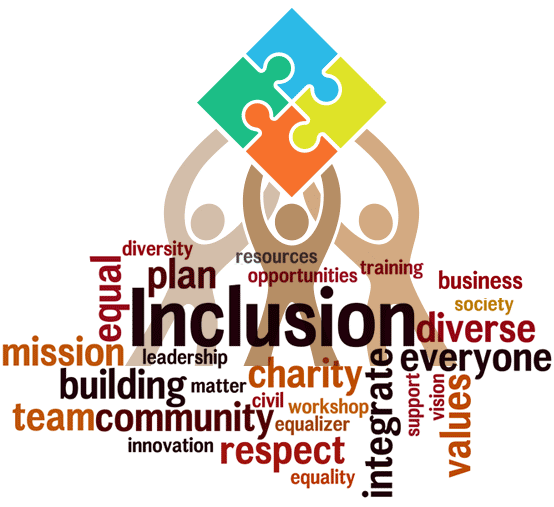
Identifying potential obstacles to the formation of inclusive education
There has been considerable criticism of the state of educational inclusiveness in the United Kingdom and there has been little evidence of significant improvement in recent years. One perspective is that inclusive education is largely a matter of finding placements in mainstream schools and colleges for as many young persons as possible. This naïve tendency to deem inclusive education as little more than merely having ‘shared places’ disregards other barriers. Within a so-called ‘integrated school’, there can exist power hubs which exhibit ableism, classism, racism, and intolerance, with scant or no respect for diversity, equity, or inclusion.
An effective and compassionate approach to inclusiveness
Holders of power within education systems should be brave enough to undertake a reappraisal of current out-of-date structures and practices. Given the everyday insulation and obstacles, it is reasonable to conclude that pathways from exclusion to inclusiveness should take account of the following domains: (1) locational and environmental placements for learners; (2) social and communal relationships; (3) curricular experiences; (4) quality of assessment, learning, and teaching; (5) opportunities to gain progress and accomplishments; and (6) the development of much more efficient professional collaboration within educational establishments and with external support agencies.
Outcomes – Everyone can benefit
Within an inclusive ethos, a commitment to implementing targeted policies, planning and resources dedicated to combating unfairness and the harshness of current systems is an essential feature across formal, informal, and shared curriculums. Learners are not expected to ‘fit’ into fixed programs of study – rather their curricular experiences are shaped to ‘fit’ their needs. Syllabuses will have clearly-stated objectives which aim to overcome regressive and negative perspectives and instead will facilitate impartiality, social responsibility, and chosen routes for the advancement of knowledge and skills.
Summary and concluding comments
A truly inclusive educational community will present a wide schedule and choice of appropriate courses for all learners in its catchment area. These curricular packages will enhance potential, attainments, and achievements while also strengthening emotional resilience, understanding, compassion, and a readiness to cope psychologically with current and future stresses. The standard and quality of progress and achievements can be maintained, indeed, improved, while promoting an ethos of equanimity and social justice.
References
In the main article there is a short list of references included for your consideration.
Link to the complete article ‘From exclusion to inclusiveness in education’ is: https://improvingcareand.education/2023/09/27/from-exclusion-to-inclusiveness-in-education/
 Improving Care and Education